
I talk to a lot of engineers in my daily life. Not a surprising fact at all — I’ve been working as an engineer and a manager of engineers for almost three decades now.
This year, as an equally low surprise factor, conversations have been more or less completely framed around AI. Previous years there were of course also some elements of this discussion, but nothing quite like 2026. The latest generation of models went from what was — in my opinion, niche — to generally strong and very capable tools that could be applied to more things than ever before.
And if you follow public discourse, e.g. on LinkedIn, your feed is almost certainly wall to wall with opinion pieces, sound bites, memes, and claims about AI. The signal-to-noise ratio is so low that if you’re on the outside looking in — trying to decide what to make of it all — I don’t blame you one bit if you’re feeling confused.
And this applies everywhere. It applies when I speak to engineers, when I speak to managers of engineers, business leaders, clients. Everywhere.
In this article, I’ll focus on things that are very close to me. Engineers — or broadly, knowledge workers — and their managers. Some are excited, many are resisting. And just to keep things well grounded, I’ve burnt literally millions of tokens to research more broadly what some of the reasons might be, what others are saying on the subject, and what — if anything — should be done about it.
Distrust, part one
Lack of trust in the tooling.
If we take a look at the Stack Overflow 2025 Developer Survey, the numbers speak volumes.
- Positive sentiment towards AI tooling sits at 60%, down from 70%+ in previous years.
- 46% of engineers distrust the accuracy of AI tools, up from 31%.
- Active use, however, sits at around 78%, up from 62% in 2024.
31%→46%
Developers who actively distrust the accuracy of AI tools — up from 31% a year earlier, even as adoption climbed. The growth at the sceptical end is the whole story.
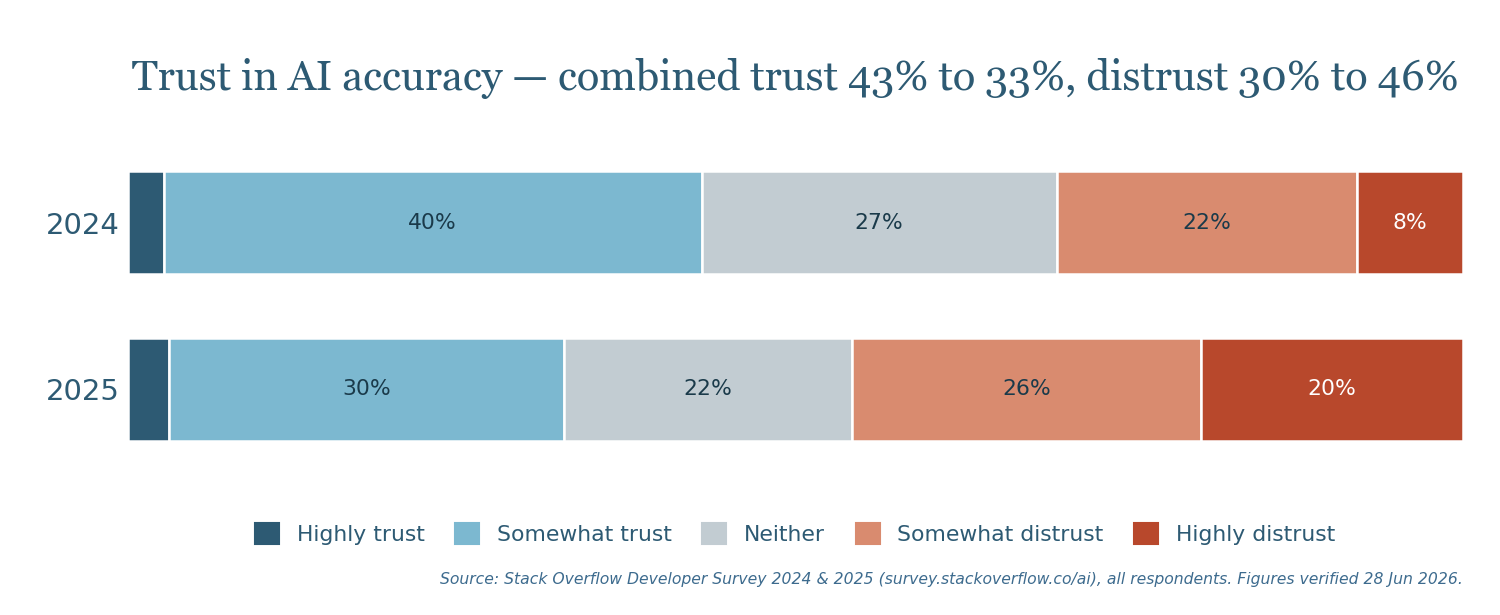
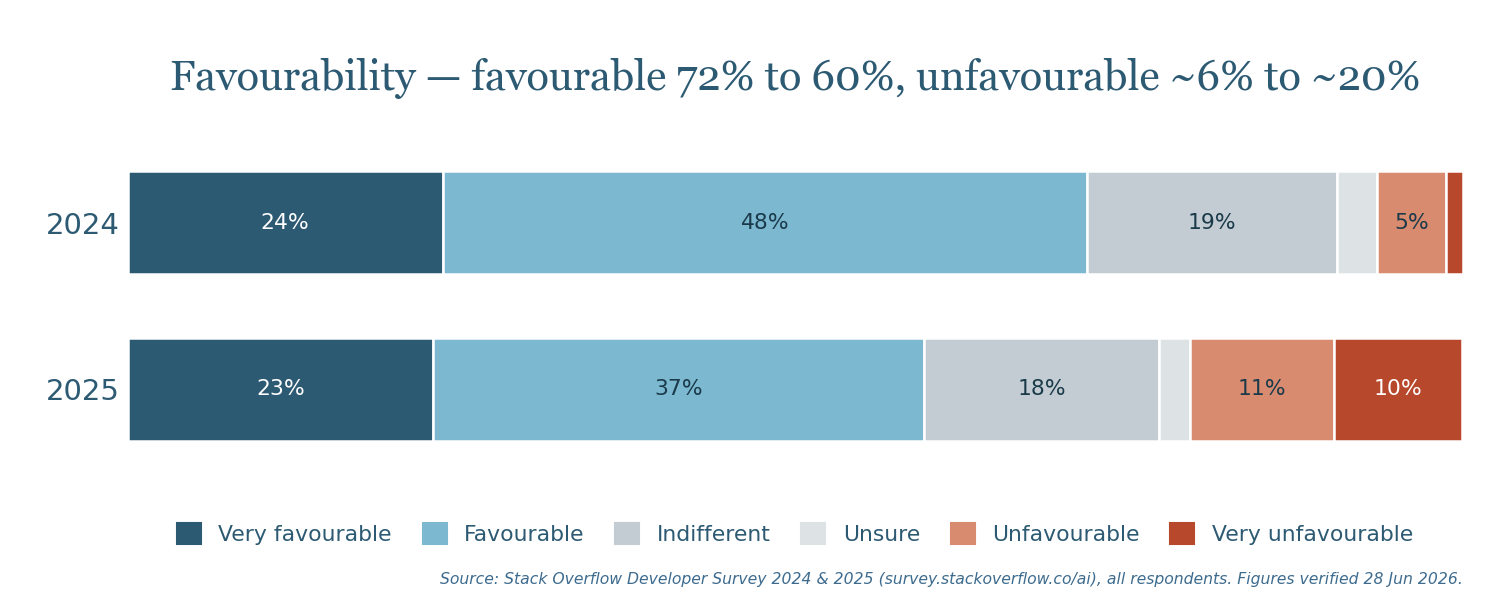
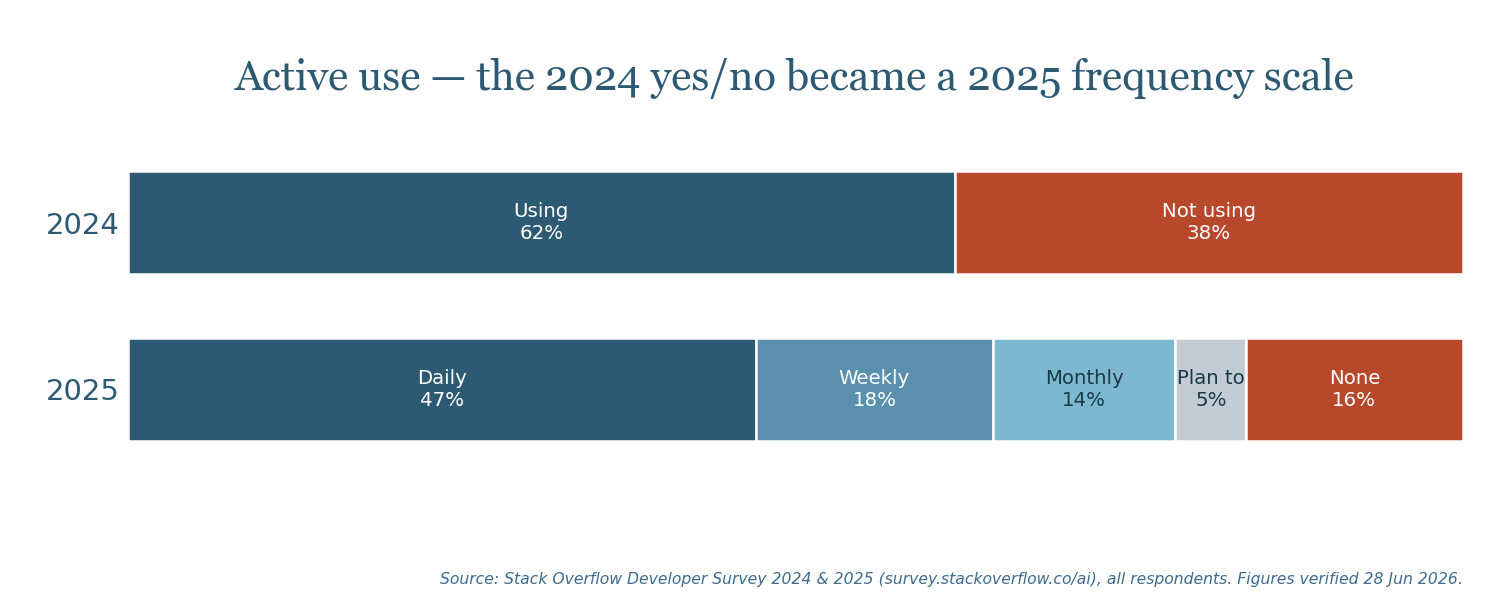
For me, the most surprising thing here is that over this period the models arguably got better. Admittedly, late 2025 was when I had my own Deep Blue Moment with the release of Opus 4.5 — and the impact of models at that level of capability would not have made it into this survey.
Yet trust went down. And while I have my own speculation and theories as to why that might be, the truth is there isn’t really any good data to support any conclusions here. Or if there is, I haven’t been able to find it.
It also doesn’t really matter what I think. Whatever the reasons, a 46% distrust is not a blip on a radar. It’s a signal you have to work with.
Distrust, part two
Lack of trust in the organisation.
There are also no prizes for guessing that knowledge workers everywhere aren’t exactly feeling too safe in their seats right now. In pretty much all of the big consulting houses, the numbers are down. AI is given the blame — either by the companies laying people off, or by sensationalist media.
It really isn’t the cause, but the narrative does have a very real and measurable impact on the market. The sentiment appears to be “AI is coming for the work these companies bill for”. I won’t speculate too much on what the future might bring. Yet I would argue that if that were true today, revenue — as opposed to stock value — would be down. And everyone, everywhere, would be building everything with AI.
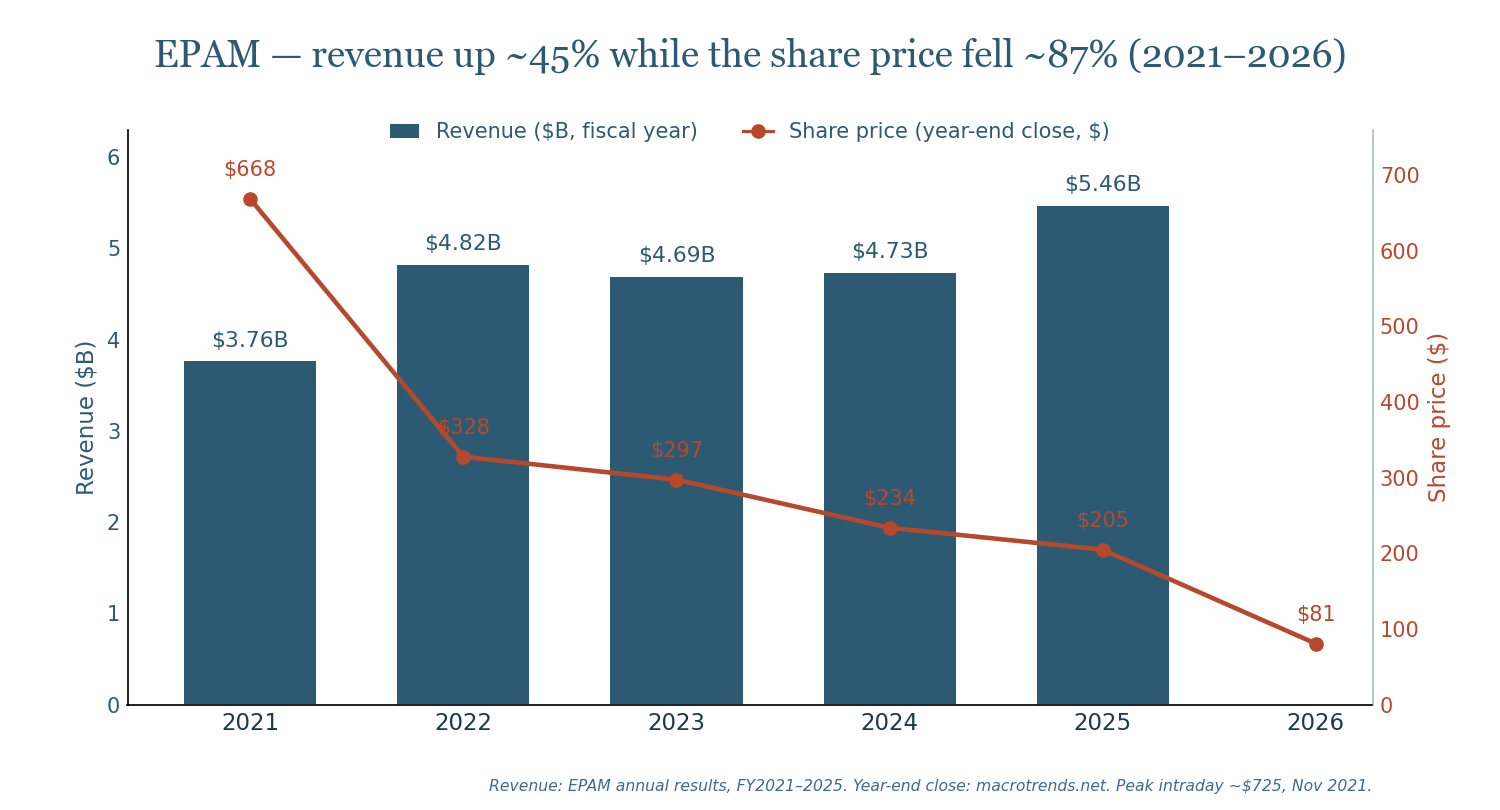
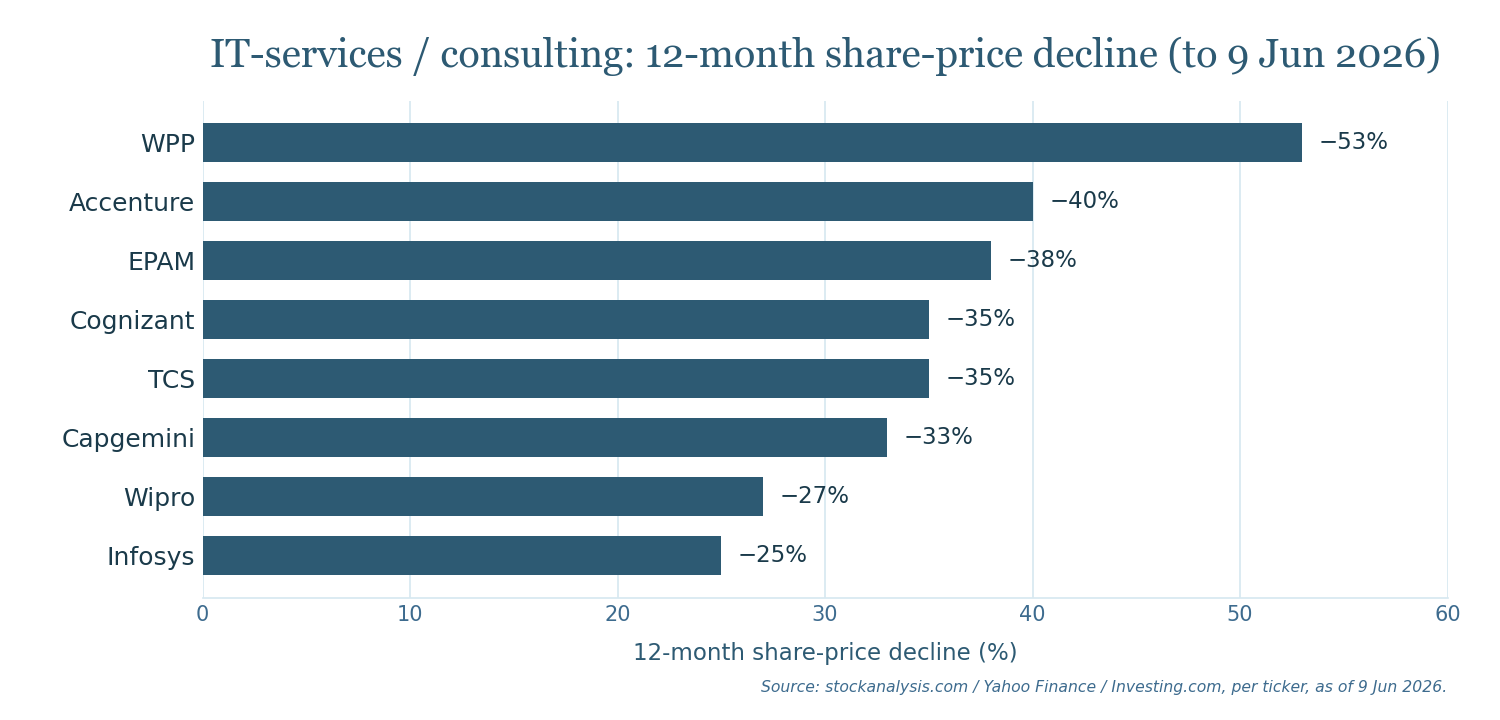
But revenue is not on the same freefall. And clients aren’t shying away from buying services because they’ve adopted AI instead.
This doesn’t change the fact that if you’re an engineer — or any kind of knowledge worker — adopting AI to essentially perform a job function that could replace you… well, it doesn’t exactly do wonders for motivation and eagerness to adopt the new technology, does it?
I have anecdotes of my own here. One engineer, almost whispering: “after being given an intro to Claude Code, I hardly ever write any code any more.” Whispering. What should be the number-one signal of an engineer keeping up with the times is being whispered in hallways and private conversations. This is so common that I’ve even begun seeing a term coined for it — the Secret Cyborg. That particular article boils it down to three reasons that all come under one heading: people don’t want to get in trouble.
- AI has been banned from use — legal or privacy concerns. And while this is a legitimate concern, it isn’t the strong argument against AI that some make it out to be. Anthropic, for instance, has HIPAA compliance. If you’re fine storing your data on Azure, AWS or Google Cloud, but not fine with the data going through AI, then there are some holes in understanding that need mending.
- Perceived value is being derived from people (managers) not knowing AI was used. An engineer finishing a task ahead of time; a marketing assistant compiling a competitive market analysis in hours instead of days. More output in less time, almost universally rewarded. People generally lose credit if it’s known that AI was involved. This one I’ve felt myself.
- Workers are worried they’re training their own replacement. Which, to be fair, is not an unfounded concern. Most companies are not like IKEA, who turned AI replacement into a business model and generated increased revenue as a result.
And I’ll add one claim of my own. If stock value is tanking — and it is — most companies will be forced to look for places to cut back costs. And while the rewarding action of “I’ve now successfully organised my work in such a way that most of it can be driven by agentic AI” should be a worker’s ticket to a safe seat, we often see the exact opposite right now.
The response
How to begin overcoming the resistance.
The heading alone already sets a direction and a tone, so I might as well spell out clearly how I see it.
AI is here to stay.
It is not a fad, its capabilities are only going to get stronger, and most of the public discourse is — in my opinion — driven out of fear and a (very normal) resistance to change. Yes, there are privacy concerns, legal concerns, sovereignty concerns, redundancies, layoffs. All of these are real concerns, and they can still co-exist with my claim.
If you’re a knowledge worker, your job was never the specific actions you took. It wasn’t writing code. It wasn’t turning over story points. It wasn’t making or reviewing pull requests. And no, it isn’t spending AI tokens either.
The job is, and always was, producing valuable outcomes — whether for the product you’re working on, the organisation you work for, or the clients you’re servicing. It was never “sitting in Visual Studio writing C# code” or “working in PyCharm writing Python”. These were always tools to achieve the former.
And the tooling has changed.
Not “is changing”. This has already happened. What you do with it decides what happens next.
And if you’re on the other side — a manager of knowledge workers, or a CxO trying to find more gains from AI in the organisation — here’s where I would start.
Reward the behaviour you want
I mean, this is “good management 101” and it seems to get lost in all the noise.
Don’t force AI down the throat of a resisting workforce. It’s not going to work. The gains will be resisted, the reports will be contradictory. If you’ve heard “I’m not sure AI is helping us much”, or you have a team of engineers whose AI adoption in the summer of 2026 amounts to “some are using it to auto-complete functions and stand up boilerplate”, this is your signal.
Instead, start rewarding inventive uses of AI.
- Team uses AI to finish that “massive milestone that HAS to be complete by Thursday EOB” on Wednesday afternoon? Reward them. Send them home. Give them back some of the time they just clawed back for you.
- Tie it into the bonus structure. When the time comes, reward employees who can demonstrate real AI-driven time or cost savings, or workable AI workflows they’ve built.
These are just two examples. What works for your organisation is for you to decide. But the bottom line is: if you want gains from AI, you should start rewarding it. Which isn’t novel by any measure, I might add. This has always been the bedrock of good management.
Make it safe to surface
Tying into this, the obvious step also needs to be one of safety. Make it safe to discuss AI. Make it safe to come forward and say “Hey, I’ve been using Claude Code to help rebuild the integrated Maps component. It was the only way we could complete the rebuild in time for next week’s launch.”
This helps you not only surface the Secret Cyborgs, but also starts giving you a real overview of how AI is being applied across your organisation. And once you have an overview, you’re half way towards formulating a real AI strategy and budget.
Don’t use the “AI redundancies” excuse for rounds of layoffs. I think this one is the most important. No one is going to work with you on AI initiatives when AI in your organisation is being used as a layoff trigger.
It’s fairly obvious, I feel. But worth spelling out nevertheless.
Why this is needed at all
It’s sort of summed up already in the above. But think about it for a second. If you reward AI gains with “here’s more work” — the whole “do more with less” approach — not many people are going to be motivated to bring those gains forward. And blindly expecting more from your knowledge workers, without first putting some of these initiatives in place to encourage AI adoption, creates a fear-and-pressure culture that is going to do you no favours either.
Story points and sprint velocity: engineers will quickly learn how to game these. They likely already have, to some extent.
Be mindful of how you approach it. I think that’s the key takeaway here.
Carrot or Stick.
So what now?
So what to do about it?
It might not be possible to draw any uniform conclusions that apply to everyone from all of this. Let me instead highlight my own current position; take from that what you will.
I offer consulting services, of course — you’re more than welcome to reach out 😉
If you’re an engineer / knowledge worker
AI isn’t going away.
Time and again, history has proven and demonstrated that when big shifts happen, the world shifts with them. From hand-written assembly to compilers. From manual typesetting to DTP tools like QuarkXPress. From ox-driven farming to tractors.
Resisting it isn’t helping you. Don’t believe the hype that claims “AI is useless, unsafe, incapable of anything beyond PoCs — and therefore should be entirely discarded”. AI is a tool, a tool unlike any we have ever seen. Learning how to use it right, learning how to guardrail it, where and how to apply it where it gives us the greatest value — this is the discussion. And a very real one — I’m not in any way arguing for blind adoption.
But don’t ignore it either. I’m writing this in the summer of 2026, and by spring 2027 the AI train will have moved even further along. Make sure you’re on it.
If you’re a leader / manager
Reward the outcomes you want to see. Forget the strategy workshops that end up as PowerPoint slides and strategy decks for 2027. Start encouraging your knowledge workers to find the real gains from AI — gains that match where you are, right now, as an organisation. Encourage and reward. Then start shaping your organisation around it.
The opposite — expensive strategies pushed onto the workers — is very unlikely to produce the outcome you want. AI will and should reshape your organisation, but it’s not going to replace it. And you likely won’t be able to just hire for it.
AI isn’t going anywhere. Carrot over stick. Reward the behaviour you want to achieve. Enjoy the summer!
References
- 2025 Developer Survey — AI — Stack Overflow, 2025
- 2024 Developer Survey — AI — Stack Overflow, 2024
- Senior developers ship more AI code — Fastly, Aug 2025
- Measuring the Impact of Early-2025 AI on Experienced Open-Source Developer Productivity — METR, Jul 2025
- We are changing our developer-productivity experiment design — METR, Feb 2026
- Wall Street just sold off these IT-services stocks — The Motley Fool, Jun 2026
- Accenture just had its worst day in years — is AI coming for consulting? — The Motley Fool, Jun 2026
- Entering 2026: AI Pricing Takes Hold — William Blair, Jan 2026
- IT-service valuation update, Q4 2025 — Investec, Mar 2026
- WPP stock plunges to its lowest level since 1998 — Campaign, Oct 2025
- Morgan Stanley cuts Accenture rating on weak IT budget growth — Investing.com, Jun 2026
- Detecting the Secret Cyborgs — Ethan Mollick — One Useful Thing
- Meta to track staff's keystrokes and clicks to train its AI, report says — Euronews, Apr 2026
- IKEA turned 8,500 call agents into design consultants — PYMNTS, 2026
- How can companies incentivize AI adoption? — Knowledge@Wharton
- This company is giving workers a raise for using AI — Fortune, Mar 2026
- The four-day workweek as part of the AI conversation — Great Place to Work
- Workers are anxious, scared and insecure about AI — Fortune (ADP / Gallup), Mar 2026
- Layoffs don't deliver AI ROI; redeployment does — Gartner, via Fortune, May 2026
- The case for an AI amnesty program — Built In
- The white-collar AI rebellion — Fortune, Apr 2026
- The AI efficiency paradox — Atlassian / Fortune
- ‘Maybe We Need Some More Examples’ — paired-developer study — arXiv, Jul 2025
- Measuring engineering in the AI era — Engineering-metrics practitioners